Built-in Reference Models
The starkzee.models package provides five independent lineshape models that share a common call signature and serve as benchmarks against StarkZee’s fully coupled solver. They are grouped into tabulated models (reading precomputed databases) and analytical models.
Tabulated Models
Stehlé (MMM) — stehle
The Stehlé model reads precomputed Stark lineshapes from the Model Microfield Method (MMM) database [stehle] for hydrogen Balmer and Paschen transitions over a grid of \(N_e\) and \(T_e\) values. The tables contain the unmagnetized (\(B = 0\)) Stark + fine-structure profile as a function of a reduced detuning \(\Delta\omega/F_0\) (Holtsmark normal field units). The pipeline is:
Bilinear interpolation over the \((N_e, T_e)\) table grid (with a Fortran-style three-point hyperbolic interpolator for the detuning axis).
Thermal Doppler broadening via FFT convolution.
Normal Zeeman splitting applied after the table: the whole Stark+Doppler profile is rigidly copied to \(\omega \pm \omega_L\) (Larmor frequency) with angle-dependent \(\pi/\sigma\) weights:
\[I(\theta) = \sin^2\!\theta\,I_\pi + \tfrac{1+\cos^2\!\theta}{2}\,(I_{\sigma+} + I_{\sigma-})\]
The Stark and Zeeman effects are therefore treated as separable. This is valid only when the Zeeman splitting \(\mu_B B\) is much smaller than the Stark width. Stehlé covers arbitrary \((n_u, n_l)\) and species with no restriction on \(B\)-field value (it is simply ignored in the table lookup).
Rosato — rosato
The Rosato database [rosato] solves the Stark-Zeeman problem jointly and tabulates the result with \(B\) as an explicit table axis (\(B \in \{0, 1, 2, 2.5, 3, 5\}\) T). The pipeline is:
Interpolation over the \((N_e, T_e, B)\) grid. The \(B\)-interpolation is scaled: before blending two bracketing profiles at \(B_0\) and \(B_1\), each profile’s detuning axis is stretched by \(B_\mathrm{node}/B\). This exploits the fact that Zeeman splitting scales linearly with \(B\), aligning the \(\sigma\) components before interpolating.
Angle dependence from two real tables (parallel and perpendicular to \(\vec{B}\)), blended as \(I = I_\parallel\cos^2\theta + I_\perp\sin^2\theta\). Both tables carry the correct \(\pi/\sigma\) lineshape and width — the angle enters as a physical interpolation, not just an amplitude weight.
Thermal Doppler broadening via FFT convolution.
Rosato is restricted to deuterium Balmer lines and the table coverage \(N_e \in [10^{13}, 10^{16}]\) cm\(^{-3}\), \(T_e \in [0.316, 31.6]\) eV, \(B \le 5\) T.
Analytical Models
Lomanowski — lomanowski
Polynomial fits for the Stark FWHM from Lomanowski et al. [lomanowski]:
Coefficients \((a, b, c)\) are tabulated for H/D Balmer and Paschen lines up to \(n_u = 9\). A Voigt profile combines this Stark Lorentzian with a Doppler Gaussian. No magnetic field treatment.
Parameterized Stehlé — stehle_param
An analytical parametric fit to the Stehlé tables, providing a fast closed-form approximation to the field-free Stark profile without reading the NetCDF database.
Voigt — voigt
A pseudo-Voigt profile using the Griem \(\alpha_{12}\) Stark half-width [griem] combined with thermal Doppler broadening. Serves as a quick estimate when only order-of-magnitude Stark width accuracy is required.
Comparison with StarkZee
Feature |
StarkZee |
Stehlé |
Rosato |
|---|---|---|---|
Magnetic field |
Full simultaneous diagonalization of \(H = H_A + V_E\) |
\(B = 0\) in tables; added as rigid triplet after |
\(B\) is a table axis |
Fine structure |
Yes — spin-orbit, MV, Darwin |
No (degenerate hydrogenic) |
In tables |
Electron broadening |
GBK semi-classical, frequency-dependent |
Unified theory (more rigorous far wings) |
In tables |
Ion dynamics |
Quasi-static + optional FFM |
Static + some ion-dynamics treatment |
In tables |
Microfield |
Hooper screened |
Holtsmark/Hooper variant |
Holtsmark variant |
\(B\)-treatment |
Intrinsic to Hamiltonian |
External convolution |
\(B\)-scaled interpolation |
The most important physical distinction at \(B \ne 0\): StarkZee diagonalizes \(H = H_A + V_E\) simultaneously for all field strengths. When \(\mu_B B \sim 3n\,e\,a_0\,F\) (Zeeman and Stark splitting comparable) the eigenstates are genuine Stark-Zeeman hybrids — neither pure Zeeman nor pure Stark states. No post-processing convolution can reproduce this mixing. The separable approximation (Stehlé) and scaled-interpolation approach (Rosato) both become inaccurate in this regime.
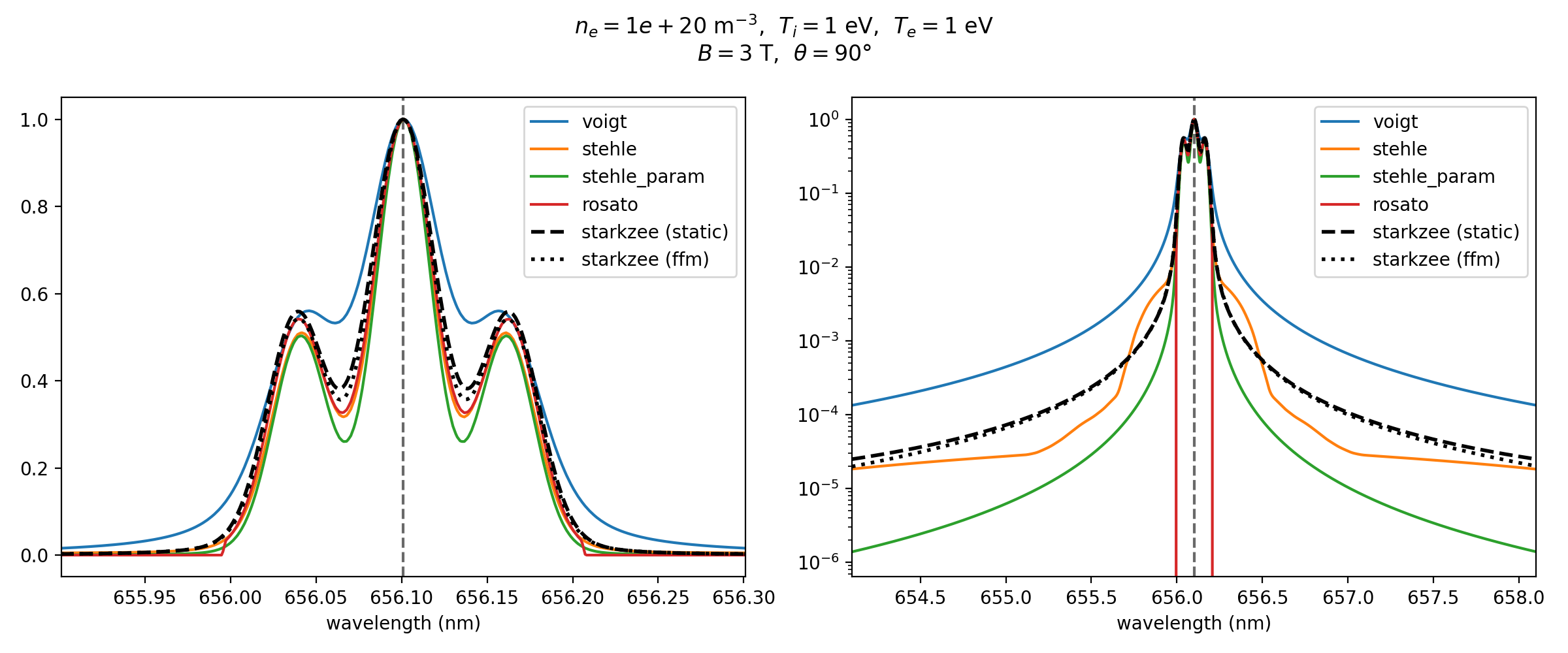
StarkZee (static and FFM) compared against four built-in reference models
(Lomanowski has no magnetic-field treatment and is disabled in this
comparison) for D\(_\alpha\) (\(n=3\to2\)) at
\(N_e = 10^{20}\) m-3, \(T_i = T_e = 1\) eV, \(B = 3\) T,
\(\theta = 90^\circ\). Linear scale (left) and log scale (right). The
field-free models (Voigt, Stehlé, Stehlé-parameterized) collapse the Zeeman
triplet into a single unsplit line, while StarkZee and Rosato — which both
treat \(B\) intrinsically — resolve the \(\pi/\sigma^\pm\) splitting.
Generated by examples/model_comparison.py.